
Blog
What to check before buying a lot in Costa Rica
A lot is the hardest decision to reverse in a whole project. It can be beautiful, well located and fairly priced, and still not let you build what you imagine. This is the list we go through at the studio before a client makes an offer.
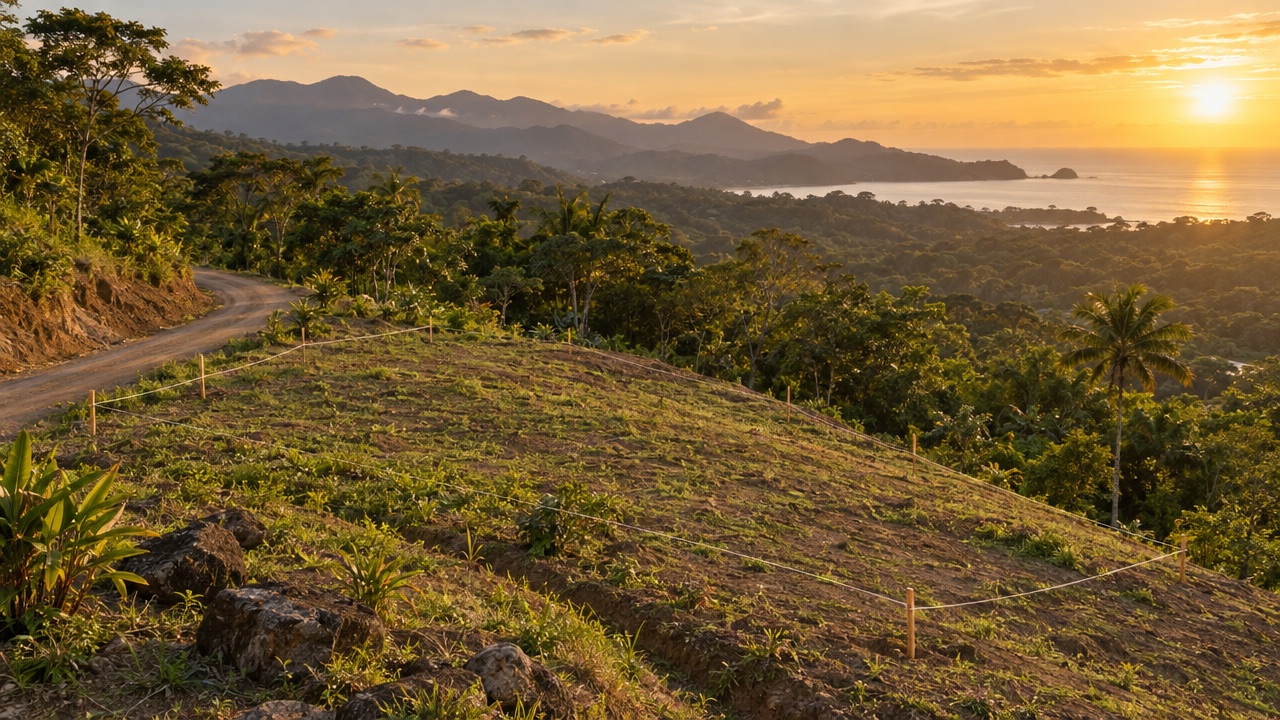
1. That the seller actually owns the lot
At the National Registry you request the property's registry certificate. It shows the owner, mortgages, liens, annotations and easements. Your notary or lawyer should review it, but it helps if you read the document too.
2. That the survey plan matches reality
Compare the area and boundaries on the plan with what you see on site. It is common for the registered area not to be the real one, or for the boundary markers not to be where the plan says. A topographic survey before signing avoids surprises.
3. Land use and zoning
Ask the municipality for the land-use certificate. If the canton has a zoning plan (plan regulador), it defines what can be built, what percentage of the lot can be covered and the allowed height. If it does not, national regulations apply. Always ask whether a house, or the project you have in mind, is allowed in that zone.
4. Setbacks
Setbacks are the strips of the lot where you cannot build: front, sides and rear. On top of these come the protection setbacks for rivers, streams and springs, set by the Forestry Law and dependent on slope and zone, and road right-of-way setbacks if the lot faces a street that will be widened. Together they can leave a large part of the lot unusable. They should be calculated before buying, not after.
5. Access and easements
Check whether the lot fronts a public road or is reached through an easement. Review its width, who maintains it and whether it is registered. Limited access can complicate the building permit and the property's future value.
6. Water, electricity and wastewater
Ask for water availability in writing from AyA, the local ASADA or the municipality, as applicable. Find out how far the power grid is and what it costs to extend it. Where there is no sewer, the lot must allow for wastewater treatment, which normally requires a soil percolation test.
7. The terrain itself
Slope, soil type and water determine how much it will cost to build. Check whether the lot is in a flood, landslide or fault zone. The National Emergency Commission publishes hazard maps that are a good first look, and a soil study gives the definitive answer. Earthworks often weigh more in the budget than the lot itself.
8. Near the sea: the maritime zone
If the lot is on the beach, confirm whether it is titled property or inside the maritime zone (zona marítimo terrestre). By law, the first 50 meters from the high-tide line are public, and the rest of the 200 meters is not sold: it is granted as a municipal concession, with its own terms and conditions. We see this often in Guanacaste.
9. Environmental viability
Depending on the project's size, type and the area's environmental fragility, SETENA may require procedures before the building permit. This can add months, and it is worth knowing before you buy.
10. Sun, wind and views
This is what makes a house comfortable to live in. Visit the lot at different times of day, and in the rain if you can. Note where the sun rises and sets, where the wind comes from and what surrounds the lot that you do not control.
What to do before making an offer
- Include a clause in the offer making the purchase conditional on land use, water availability and setbacks allowing your project.
- Take the survey plan and property number to your architect before signing.
- Visit the lot with them: an hour on site often shows what the plan does not.
This guide is general and is not legal advice. Distances and requirements vary by canton and change over time, so they must always be confirmed with the municipality and the relevant institutions.